Custom Planners & Journals with Elastic Straps
The detail that keeps a planner closed in a bag and looking finished on a desk.
An elastic strap solves a very specific problem. Planners and journals that ride around in bags, backpacks, and totes tend to flop open, bend pages, lose loose inserts, and arrive at meetings looking worn. An elastic strap keeps the cover closed, the pages flat, and any inserts the customer has tucked inside safely contained.
The strap also makes the closed product look more finished. There is something about a planner with an elastic strap that signals "this is a real tool, designed to be carried and used," as opposed to a notebook that is going to fall open the moment someone sets it down on a desk.
How the Strap Works
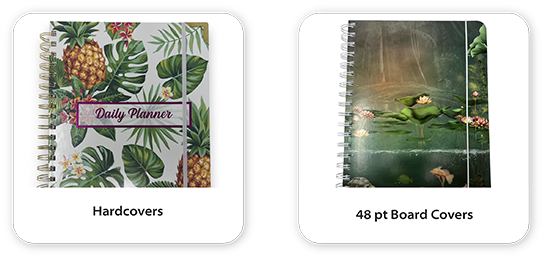
The elastic is secured to the back cover during binding. The customer stretches it over the closed planner, and it holds the cover snug without bending the binding or distorting the cover material over time. When the planner is open, the strap usually rests against the back cover, ready to be pulled across when the customer closes up for the day.
It also functions as a placeholder. Some customers use the strap itself to mark the page they were last working on by stretching it diagonally across the cover at the right spot, which is a small bonus on top of its main job.
Choosing the Right Color
Elastic straps come in a range of colors, and the choice usually comes down to whether you want the strap to disappear into the cover or stand out as a contrasting accent.
A coordinated strap (black on a black cover, navy on a navy cover) reads as understated and refined, almost invisible until the customer reaches for it. A contrasting strap (gold on navy, copper on cream, white on charcoal) reads as deliberate and a little bolder. Both approaches work well. The right choice depends on the rest of your product design.
Where Elastic Straps Work Best
Elastic straps are most commonly used with hardcover and casebound planners and journals, where the elastic can be secured to the back cover during binding. They work especially well on products customers carry around with them daily.
Elastic straps are not typically used on wire-o, plastic spiral, or saddle-stitched products, since the elastic is secured to the back cover during the hardcover and casebound binding process. For those binding types, a snap-in bookmark serves a similar marker function, though it does not keep the product closed.
How Elastic Straps Pair With Other Premium Details
Elastic straps are most powerful as part of a layered design. They feel at home alongside faux leather or linen covers, foil-stamped titles, debossed branding, ribbon markers, printed end sheets, and metal corners.
Each of these features adds a small layer of refinement on its own. Together they create a planner that feels considered, durable, and worth the price your customer paid.
Ready to Start Your Project?
Whatever stage you are at, here is where to start.