Custom Pockets for Planners, Journals & Books
A practical home for the loose pages, notes, and inserts every planner collects.
Customers fill their planners with more than just writing. Receipts they need to track, sticker sheets they bought separately, inserts that came with the planner, business cards, kids' drawings, photos, bookmarks not currently in use. Without a place to keep all of that loose material, it falls out, gets lost, or ends up taped randomly to other pages.
A pocket gives the loose stuff a home. It is one of the most practical features you can add to a planner or journal, and it is also one of the most creative. The front pocket is a perfect place to put a welcome card or a sticker sheet that ships with the product. The back pocket becomes the customer's own space, ready for whatever they want to keep with the planner over time.
Two Pocket Options
We offer two distinct pocket designs, and the right choice depends on your binding and how you want the pocket to feel as part of the product.
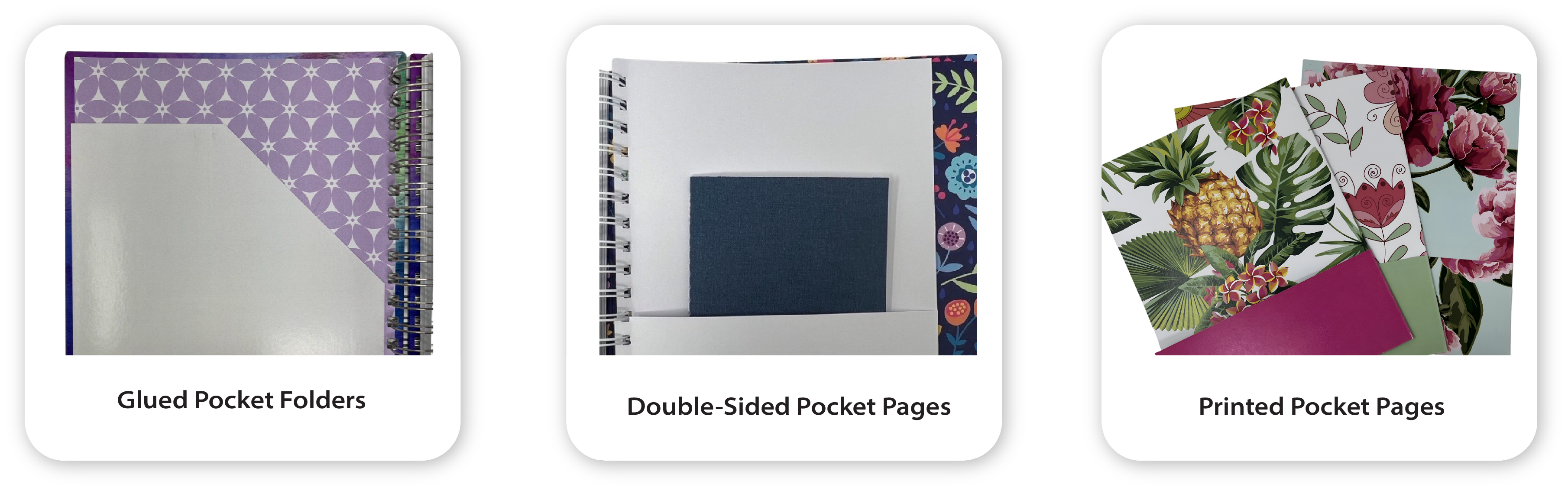
Double-sided paper pockets are folded pages with three-inch pockets on each side, sized to match your interior pages. They are designed for spiral and wire-o bound products, and they punch into the binding the same way as your interior pages so they integrate seamlessly into the structure of the planner. Available plain in white, in colored stock, or fully printed with your custom design.
Custom printed glued pockets are die-cut from heavier stock, printed with your design, and glued directly to the inside front or back cover. They work beautifully with hardcover books, casebound planners, and journals where you want the pocket to feel built into the cover rather than added as a separate page. The result is a more integrated, finished feel.
Front Pocket, Back Pocket, or Both?
Where the pocket sits matters. Customers tend to use front and back pockets for different things, and designing for that intentionally makes the product feel more considered.
A front pocket is a perfect place for materials that ship with the product. A welcome letter from you, a sticker sheet, a reference card with key information, or any printed extras included with the planner. The customer encounters this material the moment they open the cover, which makes it part of the unboxing experience.
A back pocket is the customer's own space. They fill it with whatever they want to keep with the planner over time. Notes, receipts, postcards, photos, business cards. You do not need to design content for the back pocket. You just need to leave the space.
Many of the most thoughtfully designed products use both. The front pocket holds creator-supplied materials. The back pocket is for the customer. The combination signals that you thought about how the planner would actually be used over a year of daily use, not just how it would look on the day of unboxing.
Want to see both pocket styles in person? Our sample pack includes products with both double-sided paper pockets and glued cover pockets so you can compare how they feel and how they fit different binding types. Order Samples
Ready to Start Your Project?
Whatever stage you are at, here is where to start.