Saddle Stitch and Center Sewn Books
Simple, cost-effective binding for booklets, brochures, catalogs, and inserts, stapled or sewn.
Saddle stitching is one of the simplest and most widely used binding styles, and it is a cost-effective choice for shorter publications. Sheets are folded in half and stapled along the spine, creating a clean, lightweight booklet that lies fairly flat and mails easily.
It is a natural fit for booklets, brochures, newsletters, pamphlets, direct mailers, catalogs, program guides, and printed inserts. Because the pages are folded into signatures, the page count always works in multiples of four.
We offer this folded booklet format three ways: square back saddle stitch, with the spine pressed flat for a clean, book-like edge; standard saddle stitch, stapled along the spine; and center sewn, stitched through the center fold with thread.
An economical choice for shorter page counts. Saddle stitching keeps production simple, so it is an attractive option when you want a polished booklet without the cost of a bound spine. For higher page counts or a flat spine you can print on, perfect bound books are the better fit.
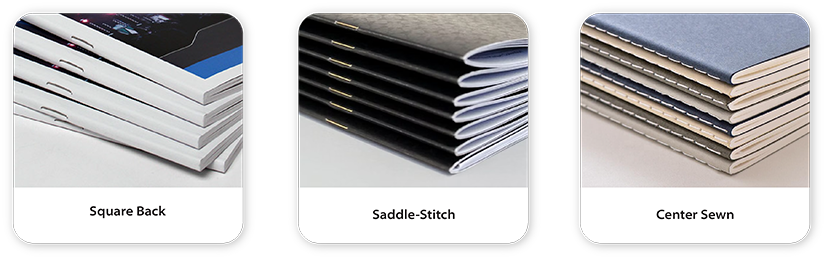
Three Ways to Bind
All three start from the same folded booklet, finished three different ways.
Option One
Square Back Saddle Stitch
The same stapled binding, with the spine pressed flat to form a square edge instead of a rounded fold.
- Stapled, then squared at the spine
- Clean, book-like flat spine
- Stacks neatly
Option Two
Standard Saddle Stitch
Folded sheets stapled along the spine, with the usual rounded fold. The most widely used booklet binding, and the most economical to produce.
- Stapled along the spine
- The most economical option
- Light and easy to mail
Option Three
Center Sewn
The same folded booklet, sewn through the center fold with thread instead of stapled.
- Thread sewn through the center fold
- No metal staples
- Holds up well to repeated handling
Sizes and Page Counts
All three bindings share the same folded format and specifications:
- Size: any size up to 8.5 x 11 inches.
- Page count: 8 to 52 pages.
- Page increments: pages must be in multiples of four to form the folded booklet.
- Construction: folded sheets stapled along the spine.
Frequently Asked Questions
What is saddle stitch binding?
Saddle stitching is a binding style where folded sheets are gathered and stapled along the spine. It is the simplest and most widely used method, and it is well suited to booklets, brochures, and other shorter publications.
What is center sewn binding?
Center sewing uses the same folded booklet format as saddle stitch, but the pages are sewn through the center fold with thread instead of stapled. It uses no metal staples and holds up well to repeated handling.
What is the difference between saddle stitch and center sewn?
Both use the same folded sheets and page counts. Saddle stitch staples the booklet along the spine, while center sewing stitches it through the center fold with thread. Saddle stitch is the most economical option, and center sewing uses no metal staples and holds up well to frequent handling.
What is square back saddle stitch?
Square back saddle stitch is a standard saddle stitched booklet with the spine pressed flat to form a square edge instead of the usual rounded fold. The stapled binding underneath is the same, but the squared spine gives the booklet a cleaner, more book-like look and lets it stack flat.
How many pages can a saddle stitched book have?
Saddle stitched books run from 8 to 52 pages, and the page count must be in multiples of four because each sheet folds into four pages.
What is the largest size you can print saddle stitched?
Saddle stitched books can be printed in any size up to 8.5 x 11 inches.
What products work well with saddle stitching?
Saddle stitching is a strong fit for booklets, brochures, newsletters, pamphlets, direct mailers, catalogs, program guides, and printed inserts.
How is saddle stitch different from perfect binding?
Saddle stitching staples folded sheets along the spine, which keeps the booklet light and economical for lower page counts. Perfect binding glues the pages into a flat, printable spine, which suits higher page counts and books meant to stand on a shelf.
Ready to Print Your Saddle Stitched Booklet?
Whatever stage you are at, here is where to start.