The Complete Guide to Creating Custom Card Decks
Handcrafted in the USA for coaches, authors, creators, and entrepreneurs ready to turn their ideas into a deck they can sell
If you have ever thought about creating your own card deck, you are in good company. Card decks are one of the most flexible and creative physical products you can sell. Tarot decks, oracle decks, affirmation decks, coaching cards, flashcards, gratitude prompts, conversation starters. The format invites people to interact with your content in a way no book or planner can match.
For 25 years, we have helped creators print custom card decks of every kind, in every size, for every audience. Every deck is handcrafted right here in the USA from your print-ready files, with low minimums starting at just 25 decks and full warehousing and fulfillment so you can focus on selling, not managing inventory. This guide walks you through everything you need to know, from your first idea to a finished product ready to ship to your customers. Whether you are creating your very first deck or expanding an existing line, you will find clear, practical answers here. And if you are still in the early planning stage, you may also want to download our free guide, How to Create a Card Deck, which walks you through the foundational decisions that shape everything else.
Jump to any section
Why sell a custom card deck? Types of card decks we print Step 1: Define your deck concept Step 2: Choose your card stock Step 3: Choose your card size and shape Step 4: Choose your packaging Step 5: Add companion products Step 6: Print, fulfill, and sell Frequently asked questions Ready to get started?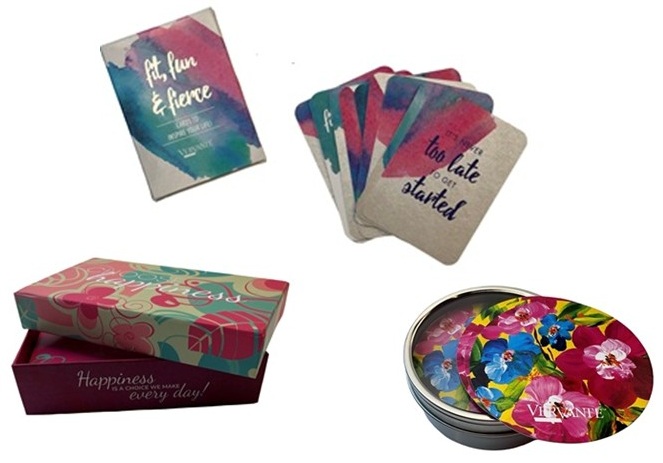
Why Sell a Custom Card Deck?
Card decks have grown into one of the most popular physical products for coaches, authors, and creators. Customers love them because cards invite presence and ritual. Pulling a card slows people down, creates a moment of reflection, and turns abstract ideas into something they can hold.
For creators, decks are an ideal product because they are versatile and brandable. The same content can support a daily practice, a coaching session, a workshop, or a gift. Decks tend to sell at strong price points, often $25 to $50 or more depending on card count, packaging, and finish, with healthy margins when produced through a quality print partner. They are also simple to warehouse and ship.
Card decks pair beautifully with other products. A deck can stand alone, or it can extend the reach of a planner, journal, workbook, or coaching program you already sell. For many creators, a deck becomes the most personal product in their lineup, the one that customers carry with them and reach for daily.
Types of Card Decks We Print
We produce every kind of custom card deck for creators, coaches, authors, educators, and lifestyle brands. Some of the most common include:
Oracle decks. Often built around a theme like nature, intuition, archetypes, or personal growth, oracle decks typically run 36 to 64 cards with a unique design on every card. They are one of the most popular deck formats for wellness practitioners, spiritual creators, and coaches building daily practice products.
Tarot decks. Traditional 78-card decks at the classic 2.75" x 4.75" size, though custom sizes are common. We print tarot decks at any quantity from a 25-deck starter run to full retail production runs, with any cover treatment and packaging option.
Affirmation decks. Short, uplifting messages for daily practice. These work well for wellness brands, coaches, course creators, and lifestyle businesses. Affirmation decks often range from 30 to 60 cards and pair naturally with a companion booklet that explains how to use them.
Coaching and prompt decks. Built around frameworks, prompts, or exercises coaches use with clients. Used in sessions, as workshop tools, or as standalone products sold inside a coaching program or course.
Flashcards and educational decks. From study aids to professional training cards, educational decks tend to run higher card counts. Many of our customers add binder rings or organize their decks into sections for easy reference.
Conversation, gratitude, and journaling decks. Question-based decks designed to spark connection or reflection. Popular with therapists, educators, families, and gift retailers. Journaling decks often use our uncoated card stock so customers can write directly on the cards.
Whatever kind of deck you are creating, the production process is the same. The decisions below walk you through how to bring yours to print.
01
Step 1
Define Your Deck Concept
Before you think about card stock or packaging, start with purpose. The strongest decks are built around a clear idea of who they are for and how they will be used.
Start by asking yourself who this is for. A coaching client, a workshop participant, a meditation practitioner, a student, a gift buyer? How will they use the deck? Will customers pull a single card each morning, work through the deck in order, use it in pairs or groups, or write directly on the cards? Is this a standalone product, or does it support a larger program, course, or book you already sell?
Card count is one of the first practical decisions. A traditional tarot deck is 78 cards. Oracle decks typically range from 36 to 64. Affirmation and coaching decks often land between 30 and 60. Educational and flashcard decks can run higher. There is no rule. The right number is the one that fits your content and your customer's experience.
The same is true of size. Cards meant to be carried in a pocket should be smaller. Cards meant for a desk practice or shared use can be larger. We can produce cards in any size, so let your content and use case guide you rather than defaulting to a standard.
Just getting started? Download our free guide, How to Create a Card Deck. It walks you through eight foundational decisions every creator faces before going to print, from defining your audience to planning your launch.
Not sure where to begin? Schedule a call with our team. We have helped thousands of creators through exactly this decision and we are happy to talk it through with you.
02
Step 2
Choose Your Card Stock
The weight and finish of your card stock shapes how the deck feels in hand. Customers notice this immediately, and it affects how often they reach for the deck.
We offer three card stock weights:
12 pt. Our most popular card stock weight, and the one we recommend for most decks. It delivers the polished, professional feel customers expect while keeping production costs manageable.
16 pt. A slightly heavier stock that adds a bit more substance in hand. A good fit for creators who want a touch more weight without moving up to our premium option.
18 pt. Our heaviest stock. Premium, durable, and noticeably substantial in hand. A strong choice for decks positioned at higher price points or designed for long-term daily use.
Our standard card stock is coated, which gives the cards a slight protective finish, a smooth shuffle, and a polished, professional look. This is the right choice for the vast majority of decks. If your customers will write directly on the cards, such as a journaling deck or a goal-setting deck, we recommend uncoated stock so pen and pencil hold cleanly to the surface.
For added durability, we can apply a gloss UV coating to the cards. This is an optional finish that adds extra protection against wear, moisture, and fingerprints. It also gives the cards a high-shine finish that makes printed colors appear richer. Gloss UV is worth considering for decks that will be handled heavily or shipped in environments where extra protection matters.
Still not sure which stock is right for your deck? Order samples and feel the difference for yourself. Or schedule a call and one of our specialists will walk you through the options based on how your deck will be used.
03
Step 3
Choose Your Card Size and Shape
One of the things that sets Vervante apart is that we are not limited to standard card sizes. We can produce decks in any size, with any number of cards, and with completely different images on the front and back of every card in the deck. There is no requirement that all cards share a back design, no limit to the number of unique illustrations you can include, and no restriction to industry standard dimensions.
That said, many creators choose familiar sizes because they are proven to work well in the hand. Common sizes include tarot (around 2.75" x 4.75"), oracle (around 3.5" x 5"), poker (2.5" x 3.5"), and bridge (2.25" x 3.5"). These dimensions feel natural to shuffle, easy to carry, and recognizable to customers. A larger format, sometimes called a coaching card or affirmation card, can run 4" x 6" or larger and works well for desk practices or display.
Corner treatment also affects how the deck feels. Rounded corners are the most common choice and shuffle smoothly without catching. Square corners give a deck a more graphic, contemporary feel and can be the right call for art decks or design-forward products. We can also produce custom shapes, including ovals, circles, and other die-cut shapes, for creators who want their deck to stand out as a visual product. Custom shapes have additional setup costs, but they create a distinctive product that customers remember.
A good starting point is to look at decks you already love. Notice the size, the corners, and how they feel. When you are ready to decide, we can send printed samples so you can feel the difference in hand before you commit.
→ Read more: New Card Shapes to Bring Your Ideas to Life
04
Step 4
Choose Your Packaging
Packaging is where card decks earn their perceived value. The cards themselves matter, but the box or bag is what customers see first, photograph for social media, and remember when they pull the deck off a shelf months later. This is also one of the most flexible parts of the process and where small choices have outsized impact on price, brand, and customer experience.
We offer a range of packaging options at every price point, from budget-friendly to luxury presentation:
Custom printed tuck box. The classic card deck box, often with a tab closure, printed in full color with your artwork. It is the most familiar packaging, prints beautifully, and gives the product a polished, professional feel. Custom printed tuck boxes have a minimum order of 50.
Plain white or clear plastic tuck box. A lower-cost alternative when you want the structure of a tuck box without custom printing. The clear plastic version lets your top card and deck design show through, which can be a smart choice for visually striking decks.
Two-piece rigid box. A telescoping box where the lid lifts off and the deck lays flat inside. Two-piece boxes feel substantial in hand and work especially well for higher-priced decks, gift sets, and decks designed as keepsakes. They also accommodate decks with companion booklets or extra inserts.
Shoulder and neck rigid box. An elegant presentation box with an inner platform that holds the deck upright for a more dramatic reveal when the box is opened. A fit for keepsake decks, signature products, and decks priced as gifts or collectibles.
Organza drawstring bag. A lightweight, low-cost option that gives a deck a soft, intentional feel. Organza bags work especially well for spiritual, mindfulness, or boutique decks, and they have lower minimums than custom boxes, which makes them an excellent choice for first runs or test batches.
Poly envelope. The most budget-friendly packaging option. Poly envelopes are clear, lightweight, and protective, making them a good fit for educational decks, sample sets, or any deck where cost matters more than presentation.
Binder rings. Not packaging in the traditional sense, but a useful alternative format for training cards, reference decks, and educational tools where customers want to flip through the cards without separating them.
Custom enhancements. Tuck boxes and rigid boxes can be enhanced with foil stamping. Boxes can also include cutout windows that reveal the top card of the deck, which is particularly useful if you want to showcase artwork or feature a personalized first card.
A real customer story. One of our creators came to us with 50 oracle cards and a small budget. She started with a print run of 25 decks, packaged in simple organza drawstring bags rather than a custom tuck box. The bags kept her unit cost low while giving the product a soft, thoughtful feel her customers loved. Demand grew, and she scaled to 250 decks, then to a run of 1,000. Today she still uses the same organza bag packaging, because it became part of her brand.
The right packaging depends on your price point, your audience, and how the deck will be sold. A boutique mindfulness deck has different packaging needs than a coaching deck sold inside a corporate program. Schedule a call and we will help you choose the option that fits your product and your goals.
→ Read more: Luxury Two-Piece Boxes Are Now More Affordable and Available in Smaller Quantities
05
Step 5
Add Companion Products
Card decks pair beautifully with other products. Many of our most successful customers do not sell a deck alone, they sell it as part of a larger ecosystem.
If you already have a planner, journal, or workbook, a card deck is one of the easiest products to add to your line. The deck becomes a daily ritual companion to the long-form work in the book, and customers who buy one product naturally cross over to the other. Decks also work as standalone gifts, lead magnets at events, or premium add-ons to a coaching program or course.
If you have a card deck and want a second product without starting from scratch, the same content can be turned into a flip book. A flip book is a bound version of your deck where each card becomes a page. It comes with an A-frame easel stand for desk display and uses your existing print-ready files, which means most of the work is already done.
A companion guidebook or booklet is one of the most natural products to pair with a card deck, and it is a real Vervante differentiator. Many printers cannot produce small books at low quantities, but we can. We print companion booklets and guidebooks at any size and any page count, from a single instructional insert card to a few-page saddle-stitched booklet to a small perfect bound book. A guidebook explains the cards, deepens the customer experience, supports a higher price point for the deck, and gives you room for context the cards themselves cannot carry. We can also package the booklet together with the deck so it ships as one product.
Other companion ideas worth considering:
- A journal sized to match the deck for written reflection
- A planner that references the deck as a daily practice tool
- A welcome kit or onboarding box that bundles the deck with branded materials
- A subscription box where the deck is the recurring centerpiece
The most successful creators we work with treat their card deck as one piece of a connected product line. Each product reinforces the others, and customers who love one are more likely to buy the next.
→ Read more: Turn Your Card Deck Into a Flip Book
06
Step 6
Print, Fulfill, and Sell
Once your design is finalized, Vervante handles the rest. Card decks can be produced as print on demand, but we strongly recommend a minimum print run of 25 decks. Single-deck runs are noticeably more expensive per deck because of the way card decks are produced. Even a small launch quantity of 25 to 100 brings the per-deck cost down meaningfully and gives you a stronger first impression and inventory ready to ship as orders come in.
After production, we store your decks in our Utah warehouse and ship individual customer orders on demand as they come in. Most creators start with a small batch to launch and test their market, then reorder as their sales grow.
Before you commit to a full print run, order a printed proof of your deck. Holding the actual product in your hands, feeling the cards, testing the shuffle, and seeing how the artwork prints in real life often leads to small adjustments that make a big difference in the final product.
One thing that sets Vervante apart from other printing services is that you can schedule a call and speak directly with a real person on our team. Our publishing specialists have helped thousands of creators through every stage of this process. If you have questions about your files, your timeline, or your fulfillment setup, someone who knows the answers is always available.
Frequently Asked Questions
What is the minimum quantity I can order?
We can produce single decks on demand, but we recommend a minimum of 25 to keep your unit cost manageable. Smaller runs have noticeably higher per-deck pricing. Tuck boxes have a minimum order of 50.
Can I print on demand?
Yes, but the economics work best at small batch quantities. Single-deck runs are noticeably more expensive per deck than even a small batch of 25. We recommend at least 25 decks per run.
How long does production take?
Production time depends on your packaging choice. Decks in generic packaging like organza drawstring bags, poly envelopes, or clear plastic tuck boxes can typically be produced and shipped within 5 to 10 business days. Decks in custom printed packaging like custom printed tuck boxes or 2-piece rigid boxes take approximately 4 weeks (20 business days). Have a launch date or event? Tell us and we will plan around it.
Can I order a sample or proof?
Yes. We offer generic samples of our standard products on our samples page so you can feel our card stocks and packaging in hand. We also offer printed proofs, which are physical copies of your specific deck. Printed proofs are priced based on your product, and we strongly recommend ordering one before placing your full print run.
Can each card in the deck be different?
Yes. Every card can have completely different artwork on both the front and back. There is no limit to the number of unique designs in your deck.
Can you produce custom shapes?
Yes. In addition to standard rectangular cards with rounded or square corners, we can produce custom shapes such as ovals, circles, and other die-cut shapes. Custom shapes have additional setup costs, and we are happy to walk you through what is possible for your project.
Can I personalize cards for individual customers?
Yes. We can produce decks where one or more cards are personalized for each customer, such as a printed name, message, or photograph. This is increasingly popular with creators using digital tools to deliver customized experiences.
Do you help with design?
Vervante provides print specifications, and templates for many of our products, so you or your designer can set up files correctly. View them at the link below.
What file format do I need to submit?
We accept print-ready PDFs. View our Print Specifications and Templates here.
What if I have questions I cannot find answers to?
Schedule a call with our team. Unlike most printing companies, you can speak directly with a real publishing specialist who will talk through your project personally. No ticket queues, no chatbots.
Ready to Start Your Project?
Whatever stage you are at, here is where to start.